


Twindor Casino: What Does a Modern Online Gaming Offering Look Like?
- Category: Pics |
- 23 Oct, 2026 |
- Views: 304 |

The iGaming industry continues to evolve at a rapid pace, driven by emerging technologies, shifting consumer expectations, and refined regulatory frameworks worldwide. Players evaluating an online entertainment venue in 2026 look far beyond bright graphics and flashy splash screens. They demand robust software stability, absolute transaction transparency, flexible financial methods, and personalized user journeys. A competitive platform must merge these technical and operational components smoothly to maintain long-term user trust and high engagement levels.
To accommodate scaling player bases across disparate regions, leading platforms rely on geographically distributed server networks. This infrastructure minimizes latency during peak traffic hours, ensuring user account data remains synchronized without service interruptions.
Understanding the structural design of an advanced gaming hub requires analyzing how software integration, user experience design, data security protocols, and operational transparency interact. Digital environments such as twindor illustrate how modern operators align their technological architecture with contemporary market standards. Examining these specific operational attributes provides clear insight into what truly differentiates top-tier virtual gaming destinations from legacy operators in the modern market.
Defining the Features of Contemporary iGaming Platforms
Establishing a competitive digital casino requires a solid technical foundation built upon reliable backend architecture and diverse content libraries. Operators must collaborate with reputable international software studios to present a comprehensive catalog that appeals to varied player demographics. High-speed streaming infrastructure, sophisticated algorithm verification, and minimal loading times serve as baseline technical requirements for quality assurance. Modern gaming enthusiasts expect immediate access to traditional table titles, live streaming dealer games, and feature-rich video slots without encountering unexpected performance latency. These foundational benchmarks ensure that every user interaction remains engaging, responsive, and completely reliable regardless of active user traffic.
Game Selection Variety and Software Integration Standards
A balanced portfolio remains essential for satisfying the diverse preferences of modern global players. Evaluating software distribution across distinct content categories reveals how advanced platforms build balanced and engaging catalog ecosystems.
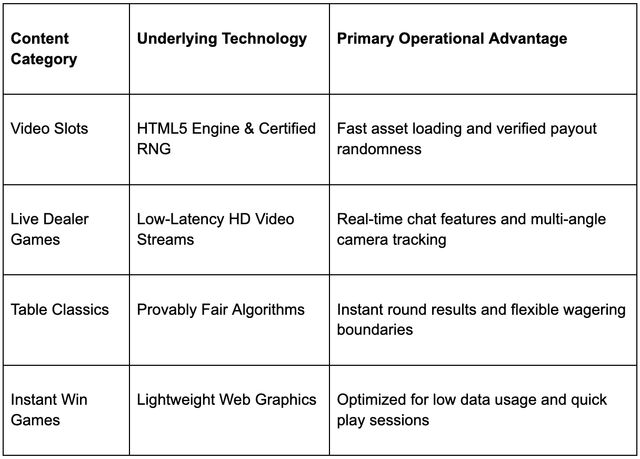
Integrating games from dozens of independent, licensed developers prevents software monotony and establishes operational redundancy. Modern aggregator platforms handle API integrations efficiently, enabling real-time synchronization of progressive jackpot pools across participating games. Furthermore, provably fair algorithms utilize cryptographic seeds, allowing participants to verify round outcomes independently. Frequent updates to the gaming library maintain fresh user interest while showcasing ongoing industry breakthroughs in graphic rendering, sound design, and interactive bonus mechanics.
User Experience and Seamless Cross-Device Performance
Navigating a contemporary digital platform should feel effortless whether a participant accesses the system from a desktop terminal, tablet, or smartphone. Interface architects prioritize clean, decluttered designs that allow visitors to search for titles, manage personal balance limits, and request withdrawals with minimal steps. Responsive web design principles ensure that visual components automatically adjust to match any screen resolution or device orientation without breaking layout structure. Eliminating unnecessary pop-up elements and streamlining internal page navigation significantly enhances overall user satisfaction during long sessions. When system performance remains uniform across diverse hardware configurations, brand loyalty increases naturally among active participants.
To bridge native apps and browser access, operators deploy Progressive Web App (PWA) frameworks. PWAs cache key assets locally, delivering rapid load times while protecting gameplay states during minor network fluctuations.
Mobile Accessibility and Intuitive Interface Navigation
Mobile compatibility has transitioned from a supplemental feature into an absolute necessity for global operators. Engineering teams build web applications using mobile-first strategies to ensure smooth touch-screen functionality across all operational tasks.
• Touch-Optimized Interface: Menu buttons and filtering options are positioned to prevent accidental clicks on compact smartphone screens.
• Dynamic Content Streaming: High-resolution media files load adaptively based on available network bandwidth to conserve mobile data.
• Integrated Cashier Access: Financial portals connect directly with native digital wallets and banking apps for frictionless deposits.
• Persistent Search Architecture: Smart search bars and category tags remain accessible at all times to facilitate swift game discovery.
These deliberate design decisions enable players to switch between hardware devices seamlessly without re-learning platform navigation or sacrificing access to core balance management tools.
Security Standards and Transparency in Virtual Gaming
Data protection and financial security represent the absolute core of any trustworthy online gaming venue. Platform users require absolute confidence that personal details, payment histories, and activity logs remain immune to unauthorized external access. Modern operators utilize multi-layered security frameworks, combining 256-bit SSL encryption, rigorous identity verification systems, and isolated database servers to secure sensitive data traffic. Modern risk assessment tools monitor system behavior continuously to detect unusual transaction patterns and prevent unauthorized account access attempt early.
Regulatory compliance mandates strict adherence to Anti-Money Laundering (AML) and Know Your Customer (KYC) directives. Advanced verification engines streamline identity checks by processing document uploads automatically, significantly shortening account approval timelines. On client devices, integration with biometric standards—such as fingerprint and facial scanning via WebAuthn—replaces static credentials with hardware-encrypted security. Furthermore, player deposits are held in segregated operational accounts, guaranteeing that user balances remain completely insulated and fully withdrawable at all times.
Beyond technical encryption, operational transparency plays a pivotal role in establishing real marketplace credibility. Legitimate gaming hubs publish return-to-player percentages, display official regulatory licensing information, and subject their Random Number Generators to periodic audits by independent testing labs like eCOGRA or GLI. Straightforward bonus terms, readable privacy policies, and clear withdrawal procedures eliminate friction, ensuring visitors clearly understand platform rules before depositing real funds.
Promotional Structures and Flexible Customer Support
Promotional models in 2026 prioritize clarity, value, and sustainable player engagement rather than predatory conditions. Legacy marketing schemes heavily weighted with unrealistic wagering multipliers have largely been replaced by transparent cashback structures, clear deposit matches, and visible loyalty progression metrics. Non-sticky bonus terms allow cash balances to be played first, ensuring players can withdraw real winnings without forced playthrough rules. Interactive user dashboards display real-time wagering progression meters, removing ambiguity. Clear bonus terms enable users to evaluate promotional value accurately and calculate play requirements without encountering hidden operational caveats.
Customer assistance infrastructures serve as another direct indicator of an operator's dedication to quality service. Contemporary support networks utilize multiple direct communication channels to resolve technical or financial inquiries rapidly. Automated routing tools categorize incoming tickets, directing technical issues immediately to specialized representatives. Payment integration options have expanded alongside support upgrades, offering direct instant bank transfers, e-wallets, and localized checkout rails for smooth account funding.
1. 24/7 Real-Time Live Chat: Delivers immediate operational assistance from trained support staff for urgent account or software inquiries.
2. Searchable Help Databases: Features organized knowledge bases that explain verification requirements, deposit rules, and system settings.
3. Dedicated Ticketing Email Channels: Manages detailed account reviews, technical log submissions, and identity verification documents systematically.
Maintaining constant multi-channel accessibility ensures that technical hiccups, verification delays, or transactional questions are handled professionally and promptly at any time of day.
Elevating Entertainment Standards for Contemporary Players
The benchmark for modern virtual gaming venues relies on a seamless balance of technological stability, diverse gaming selection, ironclad data protection, and transparent customer relations. As digital technologies continue to advance, platforms that prioritize technical optimization, clear financial terms, and user accessibility will continuously define the industry standard across competitive markets. Exploring refined iGaming hubs provides modern players with a secure, highly accessible, and satisfying digital entertainment environment.
To maintain these high operational standards over long service lifecycles, platforms must also integrate comprehensive responsible gaming tools directly into their core architecture. Features such as customizable deposit caps, session timer alerts, loss limits, and automated self-exclusion mechanics empower players to maintain healthy gaming habits effortlessly. Real-time telemetry systems can detect erratic wagering patterns, prompting proactive support intervention or suggesting temporary cooling-off periods to mitigate potential player risk.
Furthermore, the ongoing evolution of iGaming relies heavily on continuous deployment cycles and microservices architecture. This modern technical framework allows engineering teams to introduce security patches, add payment gateways, and publish software releases seamlessly without interrupting ongoing gaming sessions or causing unexpected downtime. Operators that view technical stability, player well-being, regulatory compliance, and operational flexibility as interconnected priorities are best positioned to define the future of digital entertainment for years to come.