


Do all cats like to play?
- Category: Pics |
- 7 Oct, 2026 |
- Views: 334 |
Play is one of the most recognizable feline behaviors. Kittens chase moving objects, wrestle with littermates, leap at toys, and investigate almost anything that moves. Adult cats may stalk a feather wand or suddenly sprint through the house, while some senior cats appear interested in little more than watching the action. These differences raise a simple question – do all cats actually like to play? The answer is more complicated than a simple yes or no.
Healthy cats generally retain behaviors connected with exploration and predation, but the intensity and form of play vary considerably between individuals.
Breed alone does not determine how playful a cat will be. Someone researching maine coons for sale, for example, may encounter general descriptions of breed temperament, but these cannot predict the exact activity level of an individual kitten. Age, health, early experiences, environment, personality, and the type of stimulation available all influence how often a cat chooses to play.
Play is particularly important because many feline games reproduce elements of hunting. Stalking, chasing, pouncing, grabbing, biting, and kicking toys resemble components of predatory behavior. A domestic cat does not need to be hungry to perform these actions. This is why a cat that has just eaten may still enthusiastically chase a toy moving across the floor.
Why kittens play so much
Kittens usually display a much stronger play drive than mature cats. During early development, they interact with littermates through chasing, wrestling, pouncing, and other forms of social play. Feline veterinary guidelines note that intercat social play peaks at approximately 12 weeks of age, after which object play becomes increasingly prominent. Predatory-style play commonly continues throughout the first year.
These activities also allow kittens to practice coordination. Jumping onto a moving object requires balance, timing, visual tracking, and control of the limbs. Wrestling with another kitten involves adjusting force and reacting to rapid movements. Play therefore provides both physical activity and opportunities to practice behaviors that are part of the normal feline repertoire.
A kitten's background can influence its behavior as well. People comparing kittens from breeders, shelters, private homes, or websites such as https://www.kittensup4sale.com/oriental should remember that breed labels provide only part of the picture. Early social experiences, housing conditions, opportunities for exploration, health, and individual temperament can all affect how readily a kitten interacts with toys and people.
Adult cats do not stop playing
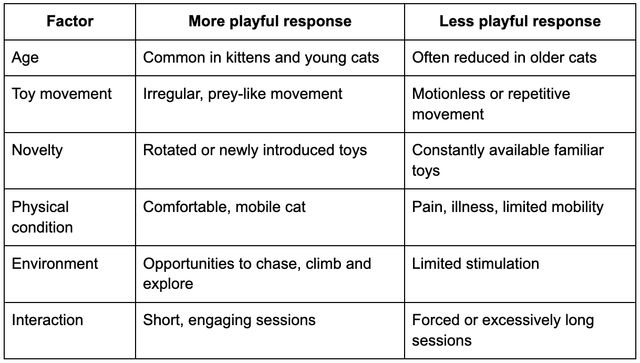
The transition to adulthood does not eliminate the motivation to play. What often changes is frequency, duration, and preferred activity. An adult may ignore a toy lying motionless on the floor but immediately become interested when the same object moves like prey.
This distinction is important. Owners sometimes conclude that their cat "doesn't play" after buying several toys that remain untouched. The problem may be presentation rather than motivation. A feather wand dragged behind furniture can trigger stalking, whereas a feather toy permanently left in the middle of the room eventually becomes part of the background.
Habituation helps explain why novelty matters. Repeated exposure to the same unchanging stimulus can reduce an animal's response to it. Rotating toys rather than leaving every toy available continuously can therefore help maintain interest. Feline environmental guidelines specifically recommend toy rotation as one strategy for reducing habituation and boredom.
Different cats prefer different games
There is no universal feline toy. One cat may enthusiastically chase objects through the air while another prefers toys moving close to the floor. Some enjoy retrieving lightweight objects. Others are more interested in food puzzles, cardboard boxes, tunnels, climbing structures, or searching for hidden objects.
These preferences can reflect different elements of hunting behavior. Fast movement along the ground can resemble small terrestrial prey, while irregular movement through the air can attract cats interested in flying targets. Toys that disappear behind furniture can also stimulate searching and stalking.
A useful approach is to test several categories rather than repeatedly offering variations of the same toy.
Age changes play rather than eliminating it
Senior cats can still play. Veterinary environmental guidelines explicitly recognize that older cats continue to need play opportunities, although the type and intensity may require modification.
An older cat may prefer shorter sessions, slower-moving toys, or activities that require less jumping. A food puzzle can provide stimulation without demanding repeated high-speed movement. A wand toy can also be moved slowly across the floor instead of high into the air.
Owners should therefore avoid comparing an older cat's behavior with that of a six-month-old kitten. Reduced intensity can be a normal consequence of aging. A complete and sudden loss of interest, however, deserves closer attention.
When lack of play may indicate a health problem
Behavior can provide useful clues about physical health. A cat that previously played regularly but suddenly stops may be experiencing pain, weakness, illness, or another physical problem.
Joint discomfort is particularly relevant in older cats. Activities such as jumping, twisting, running, and pouncing become less attractive when movement hurts. Dental problems and other painful conditions can also change normal behavior.
Look at the broader pattern rather than play alone. Reduced appetite, hiding, reluctance to jump, changes in grooming, altered sleep patterns, unusual vocalization, or changes in litter-box habits combined with reduced activity provide stronger reasons for veterinary evaluation.
Gradual differences are another matter. A cat that has always preferred quiet observation may simply have a calmer temperament.
Environment has a major role
Indoor cats depend heavily on their environment for opportunities to express natural behaviors. Current feline welfare recommendations include play, simulated hunting and foraging, vertical territory, scratching opportunities, safe resting areas, and other resources as important elements of an appropriate indoor environment.
This does not mean filling a home with dozens of expensive toys. Cardboard boxes, paper bags without handles, tunnels, elevated platforms, safe hiding places, puzzle feeders, and supervised interactive toys can provide different forms of stimulation.
Space matters as well. Cats use three-dimensional environments, so vertical territory can expand their usable space. Cat trees, shelves, window perches, and other elevated areas allow climbing and observation even when floor space is limited.
Interactive play is different from independent play
Some cats rarely interact with toys alone but become highly engaged when a person controls them. This happens because interactive toys can behave less predictably than static objects.
A wand toy can disappear behind a chair, stop suddenly, change direction, or move slowly before accelerating. Such variation more closely resembles the unpredictability of prey than a toy sitting permanently beside the food bowl.
Cats should also be allowed to catch the toy periodically. Constantly presenting an unreachable target can make an interactive session less satisfying. Feline environmental guidelines recommend allowing capture during predatory-style games.
Hands and feet should not be used as prey. Encouraging kittens to attack fingers may appear harmless when they are small, but it can establish an undesirable pattern that continues when the animal is larger and stronger.
Stress can suppress play
A cat's willingness to play is affected by how safe it feels. Moving house, introducing another animal, loud construction, unfamiliar visitors, competition between cats, or major routine changes can temporarily reduce exploratory and playful behavior.
Multi-cat households present additional considerations. Cats sharing a home are not automatically comfortable playing together. One confident animal may control access to a desirable area or repeatedly interrupt another cat's activities.
Providing resources in separate locations helps reduce competition. Individual play sessions can also allow a less confident cat to engage without another animal interfering.
How much play does a cat need?
There is no single number of minutes that suits every cat. A kitten with a strong play drive may initiate activity repeatedly throughout the day, whereas a senior cat may prefer several brief sessions.
Quality is more useful than simply measuring duration. Watch whether the cat voluntarily engages, stalks, chases, pounces, and returns for another attempt. Ending a session when interest naturally declines is generally more appropriate than forcing continued activity.
Owners can experiment with timing too. Cats often have periods when they are naturally more active. Offering interactive play during these periods may produce a stronger response than trying to initiate a game when the animal is preparing to sleep.
Not every cat plays in the same way or with the same intensity. Kittens usually display especially strong social and object play, while adult and senior cats may prefer shorter or less physically demanding activities. Individual temperament creates substantial variation even among cats of similar age and background.
A cat that appears uninterested in toys may actually dislike the particular toys or presentation being offered. Rotating objects, imitating prey movement, introducing puzzle feeders, providing climbing opportunities, and experimenting with short interactive sessions can reveal forms of play that better match the individual animal's preferences.
Owners should pay attention when a previously playful cat suddenly loses interest, particularly when the change occurs alongside other behavioral or physical signs. Play is only one part of feline behavior, but changes in normal activity can provide useful information about health and wellbeing. The goal is not to make every cat equally playful – it is to provide appropriate opportunities and allow each cat to choose how it engages with them.