


How to choose bet sizes through a poker hand
- Category: Pics |
- 17 Sep, 2026 |
- Views: 989 |

Bet sizing works best when each decision follows from the pot, effective stacks, position, board texture and the ranges that reached the current street. Before play, session preparation may involve bankroll notes, table information and account access at bizbet, while the amount committed to a hand should still come from the poker situation itself. A clear process makes later review easier because every size has a reason.
Preflop sizing starts with effective stacks
Begin with the effective stack, not the number of chips in front of you. If you have 100 big blinds but the opponent has 35, the hand plays as a 35-big-blind stack. That limits how many large bets can fit into later streets.
Next, identify the action before you. An unopened pot, a single raise and a three-bet pot need different starting sizes.
A useful preflop check covers:
• effective stack depth;
• position at the table;
• number of players still to act;
• size of the previous raise;
• likely calling and reraising ranges.
Choose a size only after these points are clear. Copying the same open or three-bet amount from every table ignores the conditions that shape the rest of the hand.
Flop sizing follows board and range structure
On the flop, first ask which range connects better with the board. A dry A-7-2 rainbow board often favors the preflop raiser and contains few strong draws, so a smaller continuation bet can apply pressure without building an oversized pot.
A coordinated J-10-9 board behaves differently. More two-pair combinations, straights and draws are available, so larger value bets may be justified when protection matters. Weak hands need more caution because a bigger bet also risks more against raises.
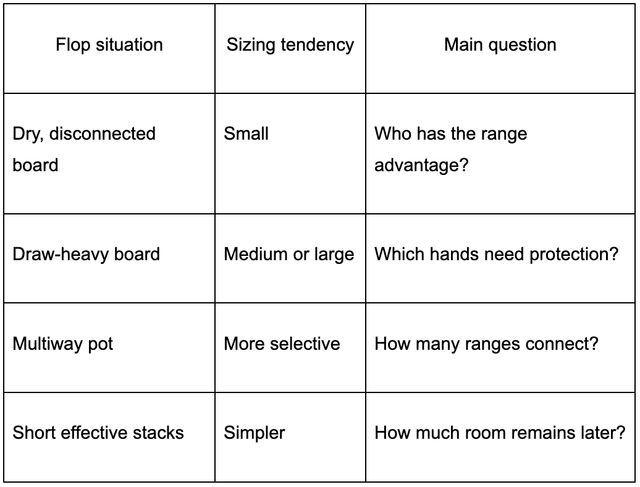
Opponent tendencies and exact ranges still determine the final choice.
Turn sizing depends on what changed
The turn should trigger a fresh calculation. Update the pot size, remaining stacks and stack-to-pot ratio before deciding whether the flop plan still works.
Then classify the turn card. A blank may preserve the earlier range advantage, while a card completing a flush or straight can shift it. Strong value hands may support another large bet, but marginal hands often prefer a smaller size or a check.
If a turn bet leaves less than one pot-sized bet for the river, you are effectively planning the final street already. Choose the turn size with that river decision in mind.
Street sizes need one connected plan
A good sizing line makes sense from preflop to river. After every action, note the new pot, effective stack and likely range changes.
Mobile sessions can be reviewed immediately after play, whether account access begins in a browser or follows a bizbet download; useful notes should still capture pot size, stack depth, board cards and every action. That information helps reveal whether an awkward river decision was actually created by an earlier bet.
Review the largest pots first. Ask whether each size achieved a clear purpose, whether a smaller or larger bet would have changed the opponent’s continuing range, and whether the remaining stack still fit the next street.
A consistent method does not guarantee a winning hand. It does make sizing easier to repeat, compare and improve because every decision can be traced back to the same inputs.
River sizing separates value from bluffs
There are no future cards on the river, so protection is no longer part of the calculation. Start by deciding whether the hand wants a call from worse holdings or a fold from better ones.
Thin value usually favors a size that weaker hands can realistically call. Very strong hands can support larger bets when the opponent reaches the river with enough bluff-catchers. Bluffs should use a size consistent with the value range they represent.
Blockers refine the choice. Holding a card that removes strong calls from the opponent’s range can improve a bluff, while blocking missed draws may reduce the combinations available to fold.