


The Loophole: Why Truckers Are Choosing the Portable Milwaukee Train Horn
- Category: Pics |
- Today, 00:02 |
- Views: 219 |
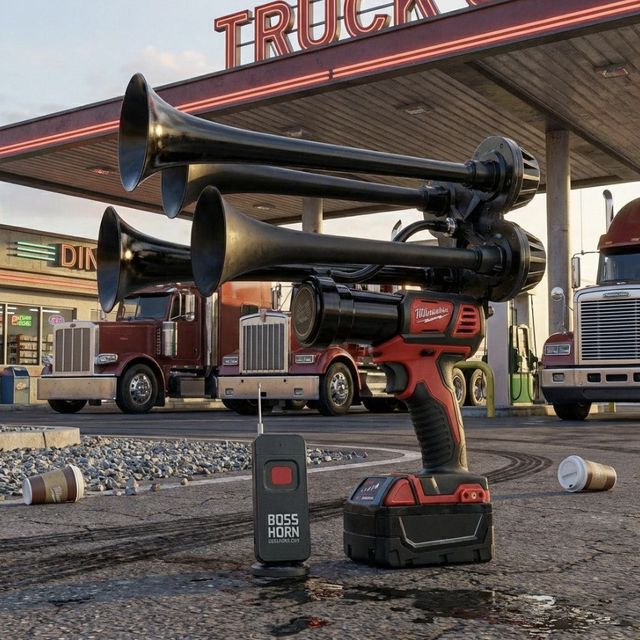
For years, the "Train Horn" was a modification reserved for the most dedicated truck enthusiasts. It required an onboard air compressor, a 5-gallon tank bolted to the frame rail, intricate airline plumbing, and a solenoid wired into the steering column. It was loud, expensive, and—crucially—a permanent modification that Department of Transportation (DOT) officers could easily spot during an inspection.
But recently, a shift has occurred in the trucking community. Drivers are bypassing the hardwired kits entirely in favor of a new, handheld solution: the Milwaukee Train Horn.
While the 150-decibel output is the main draw, the real appeal for many commercial drivers lies in a legal gray area known as "The Portable Loophole."
The "Equipment" Trap
To understand the loophole, you first have to understand the law.
In many states and under certain Federal Motor Carrier Safety Administration (FMCSA) regulations, vehicle equipment is strictly scrutinized. While having a train horn isn't explicitly illegal in every jurisdiction, using it on a public highway often violates noise ordinances or statutes regarding "unreasonably loud or harsh" warning devices.
More importantly, if a train horn is hardwired into your truck, it is technically part of the vehicle's "equipment."
• The Risk: If a DOT officer inspects your rig and sees a locomotive horn wired to your steering wheel or a toggle switch on your dash, they can flag it. In strict states, they may argue it violates equipment standards because it bypasses the factory "city horn" required for legal road use.
• The Fix-It Ticket: A hardwired system often requires you to remove the equipment to clear the citation—a mechanic’s nightmare involving unbolting tanks and capping air lines.
The Portable Loophole
This is where the Milwaukee Train Horn changes the game.
Because the device is a handheld, battery-powered tool, it is not technically "installed" on the vehicle.
• Cargo, Not Equipment: Legally speaking, a Milwaukee Train Horn sitting on your passenger seat is no different than a cordless drill or a flashlight. It is "cargo" or "personal property," not "vehicle equipment."
• Plausible Deniability: If a driver gets pulled over, the device can be tossed into a duffel bag or the sleeper berth. There are no solenoids to trace, no tanks under the chassis, and no extra switches on the dashboard.
• Inspection Proof: During a Level 1 DOT inspection, an officer is looking for mechanical faults and fixed equipment violations. They are generally not inventorying the power tools inside your cab.
Why Truckers Are Making the Switch
Beyond the legal cover, the practical benefits for over-the-road (OTR) drivers are driving the adoption of these devices.
1. Zero Installation Downtime
For an owner-operator, time is money. Installing a traditional Nathan AirChime or HornBlasters kit can take a full Saturday of drilling and wiring. The Milwaukee horn works instantly with the M18 batteries many truckers already carry for impact wrenches.
2. The "Wake Up" Call
The reality of modern trucking is dealing with distracted four-wheelers. A standard semi-truck horn is loud, but a texting driver drifting into your lane at 70 mph often needs a "nuclear option" to snap them back to reality. The 150dB blast from a Milwaukee horn cuts through soundproof luxury sedans and noise-canceling headphones in a way standard horns cannot.
3. Portability Between Rigs
Company drivers who slip-seat (switch trucks often) cannot modify their company's vehicles. A portable horn travels with them. Whether they are in a 2024 Peterbilt or a beat-up yard dog, they keep their safety advantage.
The Warning Label
While the "loophole" protects you from equipment violations, it does not protect you from noise violations.
Usage is Still Regulated: If a state trouper hears you blast 150dB in a residential zone or non-emergency situation, you can still be cited for "disorderly conduct" or "unnecessary noise," regardless of whether the horn is handheld or hardwired.
The Bottom Line: For truckers, the Milwaukee Train Horn offers a powerful safety tool without the commitment of a permanent install. It allows drivers to "speak softly and carry a big stick"—or in this case, drive quietly and carry a very loud drill.